

AI lead generation
“Don't send a thousand generic emails. Find the businesses with a real problem, and say what it is.”
The product
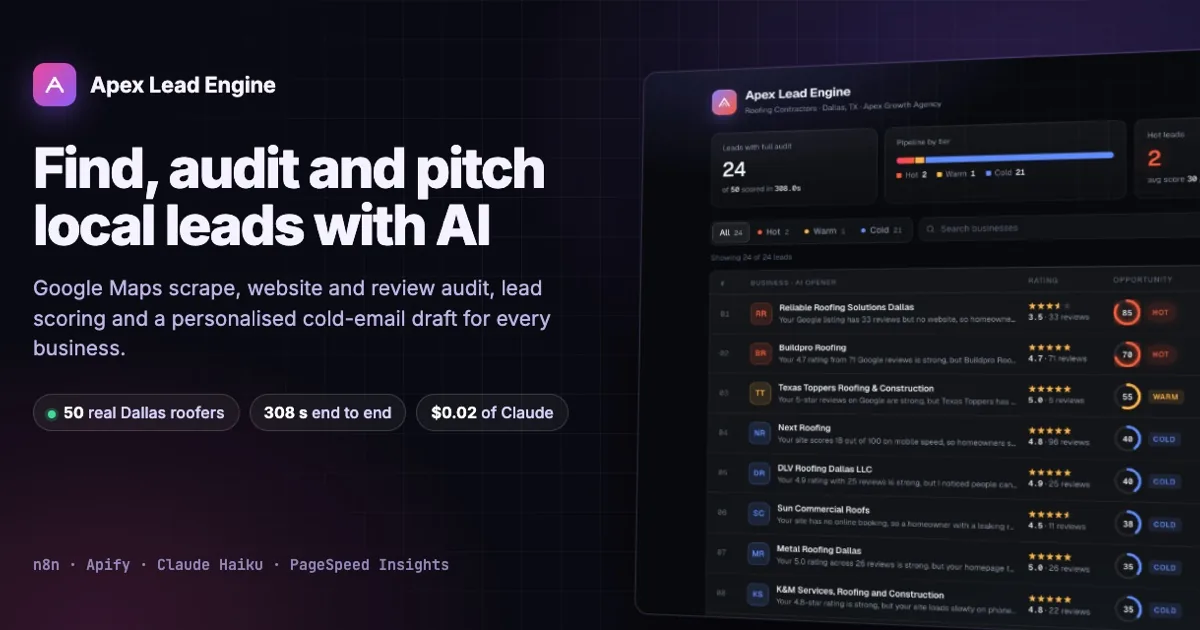
github.com/moezkayy/apex-roofing-ai-leadgen ↗
In numbers
The idea
Agencies that sell to local businesses spend hours picking prospects, then still send emails that could be about anyone.
This system does the research. Built around a made-up agency hunting for roofers in Dallas, it pulls businesses from Google Maps, checks each website and its reviews, scores every lead with written reasons, and has Claude draft an opener based only on what the checks actually found.
Every line in a draft points at something that was checked.
What it does
- Finds businesses. Google Maps listings for any search and city, through Apify.
- Audits each one. Does the site load, work on a phone, take online bookings, and how fast is it (Google PageSpeed)? Plus complaints in recent reviews.
- Scores and ranks. A 0–100 score from a written rubric, a hot, warm or cold tier, and the reasons for every point.
- Drafts the pitch. Claude writes a one-line opener and a short pitch for each lead, from the audit facts only.
- Hands it over. A dashboard to browse leads and copy drafts, plus JSON and CSV export. Nothing is sent automatically: a person reads every email first.
How it's built
An n8n workflow runs the pipeline. The logic (cleaning, auditing, scoring, prompts and output) is plain JavaScript with unit tests, so it can be checked outside n8n.
A mock mode runs the whole thing with no accounts or keys, on sample data, so anyone can try it for free.
Real cost is measured, not guessed: about $0.0004 of Claude per lead and $0.42 of Apify for the 50-lead run. A spot check against real homepages found the AI didn't invent facts; the misses came from the simple website rules, and the README says so.
Stack
Note
Built for my portfolio, made for a fictional agency. It is not client work. The numbers are from a real run on live Google Maps data on 8 October 2026.